
A square sheet of paper is folded along the dotted lines…
Question & Answer (English)
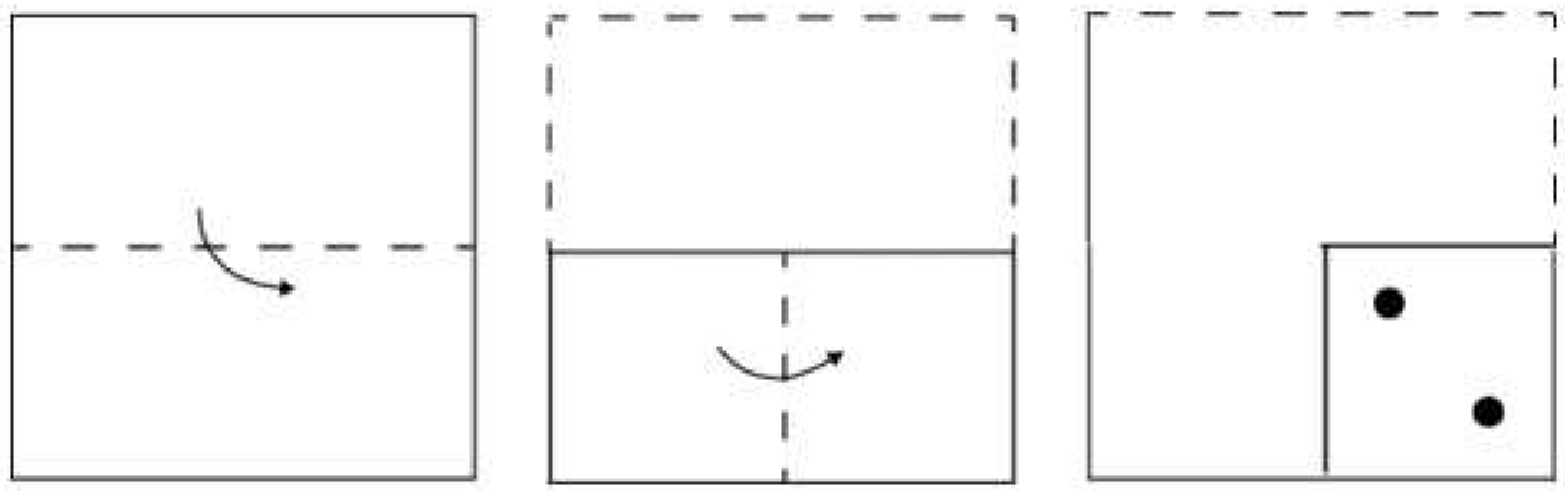
A square sheet of paper is folded along the dotted lines successively in the directions shown and is then punched in the last. How would the paper look when unfolded?
- — Correct Answer
Analysis of the folding and punching process:
- First Fold: The square paper is folded from top to bottom. Now, we have a rectangular strip representing the bottom half of the original paper.
- Second Fold: The strip is folded from left to right. Now, we have a smaller square representing the bottom-right quadrant of the original paper.
- Punching: Two holes are punched in this folded square:
- One hole is near the top-left corner of the folded square. This corner corresponds to the center of the original sheet where the horizontal and vertical fold lines intersect.
- One hole is near the bottom-right corner of the folded square. This corresponds to the bottom-right corner of the original sheet.
Unfolding Steps:
- First Unfold (Right to Left): When we open the last fold, the pattern mirrors across the vertical center line.
The hole at the bottom-right reflects to the bottom-left corner.
The hole near the center fold reflects to the other side of the vertical line.
At this stage (bottom half of the paper), we have two holes at the bottom corners and two holes near the center of the top edge. - Second Unfold (Bottom to Top): When we open the first fold upwards, the pattern mirrors across the horizontal center line.
The two holes at the bottom corners reflect to the top corners. This results in holes at all four corners of the sheet.
The two holes near the center reflect upwards. This results in a cluster of four holes in the center of the sheet.
Conclusion: The unfolded paper will have four holes at the four corners and four holes arranged in a small square at the center.
This pattern matches Option 2.
प्रश्न एवं उत्तर (हिंदी)
कागज की एक वर्गाकार शीट को बिंदीदार रेखाओं के साथ दिखाए गए निर्देशों के अनुसार क्रमिक रूप से मोड़ा जाता है और अंत में उसमें छेद (पंच) किए जाते हैं। कागज को खोलने (unfold) पर वह कैसा दिखाई देगा?
- — सही उत्तर
कागज को मोड़ने और पंच करने की प्रक्रिया का विश्लेषण:
- पहला मोड़ (First Fold): वर्गाकार कागज को ऊपर से नीचे की ओर मोड़ा जाता है। अब हमारे पास एक आयताकार पट्टी है जो मूल कागज का निचला आधा हिस्सा है।
- दूसरा मोड़ (Second Fold): उस पट्टी को बाएं से दाएं मोड़ा जाता है। अब हमारे पास एक छोटा वर्ग है जो मूल कागज का निचला-दायां हिस्सा (quandrant) है।
- पंचिंग (Punching): इस मुड़े हुए वर्ग में दो छेद किए गए हैं:
- एक छेद मुड़े हुए वर्ग के ऊपरी- बाएं कोने के पास है। यह कोना मूल शीट के बिल्कुल केंद्र में आता है।
- एक छेद मुड़े हुए वर्ग के निचले-दाएं कोने के पास है। यह मूल शीट के निचले-दाएं कोने से मेल खाता है।
कागज को खोलने की प्रक्रिया (Unfolding):
- पहला अनफोल्ड (दाएं से बाएं): जब हम आखिरी तह खोलते हैं, तो पैटर्न ऊर्ध्वाधर (vertical) रेखा पर प्रतिबिंबित होता है।
निचले-दाएं कोने का छेद निचले-बाएं कोने पर भी बन जाता है।
केंद्र के पास वाला छेद वर्टिकल लाइन के दूसरी तरफ प्रतिबिंबित होता है। अब नीचे के आधे हिस्से में दो छेद कोनों पर और दो छेद बीच में ऊपर की तरफ हैं। - दूसरा अनफोल्ड (नीचे से ऊपर): जब हम पहली तह को ऊपर की ओर खोलते हैं, तो पैटर्न क्षैतिज (horizontal) रेखा पर प्रतिबिंबित होता है।
निचले कोनों के दो छेद ऊपरी कोनों पर प्रतिबिंबित होते हैं। इससे शीट के चारों कोनों पर छेद हो जाते हैं।
केंद्र के पास के दो छेद ऊपर की ओर प्रतिबिंबित होते हैं। इससे शीट के बिल्कुल बीच में चार छेदों का एक समूह बन जाता है।
निष्कर्ष: खुलने के बाद कागज में चारों कोनों पर चार छेद और केंद्र में एक छोटे वर्ग के रूप में व्यवस्थित चार छेद दिखाई देंगे। यह पैटर्न विकल्प 2 से मेल खाता है।
